Why a DeFi Card That Pays You to Hold and Spend Is Such a Big Deal
There is a moment in every technology shift when the abstraction finally becomes useful for everyday life. For years, DeFi proved that self-custody, composability, and permissionless liquidity could transform the way assets move and earn. Yet there was always a catch when you tried to take that on-chain power to the checkout counter. You could hold staking ETH, yield-bearing stablecoins, tokenized Bitcoin, or any number of productive assets, but converting them into coffee, groceries, or a plane ticket often meant selling, incurring friction, losing upside, or paying clunky fees to intermediaries. The EtherFi Cash Card collapses that gap. It operates like a familiar Visa credit/debit card for everyday spending while letting you fund, collateralize, and even borrow against yield-bearing crypto without giving up your upside or your yield. The headline claims from the walkthrough are bold but surprisingly practical in day-to-day use: three to four percent cash back on spend, the ability to use ten percent APR yield-bearing stablecoins as collateral, optional borrowing against EBTC or liquid ETH without selling, and a fluid workflow for refilling the card from any wallet you already use. If you have ever wished your checking account actually earned a meaningful return while still being spendable at any point of sale, this arrangement gets very close to that ideal.
The beauty is not merely the rate numbers flashed in a dashboard but the architecture of options. You can spend the actual token you deposit through direct pay, or you can switch to a borrow mode where your deposited asset stays intact as collateral while you effectively draw dollars against it to make purchases. That choice lets you dial your risk, tax exposure, and strategic allocation in a way that aligns with market conditions and personal preference. For the crypto-native, it means you can live on chain and still tap the legacy rails with minimal compromise. For the curious newcomer, it feels familiar enough to adopt while quietly teaching the logic of DeFi under the hood.
In this long-form guide, we will step through the full experience described in the video demo, then expand each step with context, rationale, risk management, and practical tactics. You will learn how to open the account, pass KYC, connect a wallet, deposit assets, mint and use yield-bearing stablecoins, switch between direct spending and borrow mode, harvest cash back that accrues in Scroll tokens, handle promotions that boost your effective APR, and convert rewards back into the asset mix you want. Along the way we will talk about how the vault works, what loan-to-value and interest spreads mean in practice, how to avoid liquidation when borrowing, and how to think about fees, security, taxes, and travel perks. The goal is not to hype a card but to equip you with a mental model for using a yield-backed spending instrument responsibly and advantageously in real life.
What the EtherFi Cash Card Actually Is
The EtherFi Cash Card is presented as a Visa debit/credit-style instrument designed for global, everyday use, funded by crypto that you control. It connects a familiar card interface to a vault where you keep the assets you want to spend or borrow against. The vault can hold standard tokens such as USDC and USDT, wrapped ETH, and EtherFi’s own token, but the core experience revolves around liquid or yield-bearing versions of major assets: LiquidUSD for market-neutral stablecoin yield, Liquid ETH for staked ETH-style yield exposure, and EBTC or Liquid BTC for tokenized Bitcoin. When you fund the card with a yield-bearing asset, you do not have to liquidate it to spend unless you choose direct pay. If you pick borrow mode instead, the card pulls purchasing power against that collateral while your asset continues to earn and, if it appreciates, continues to compound your net position.
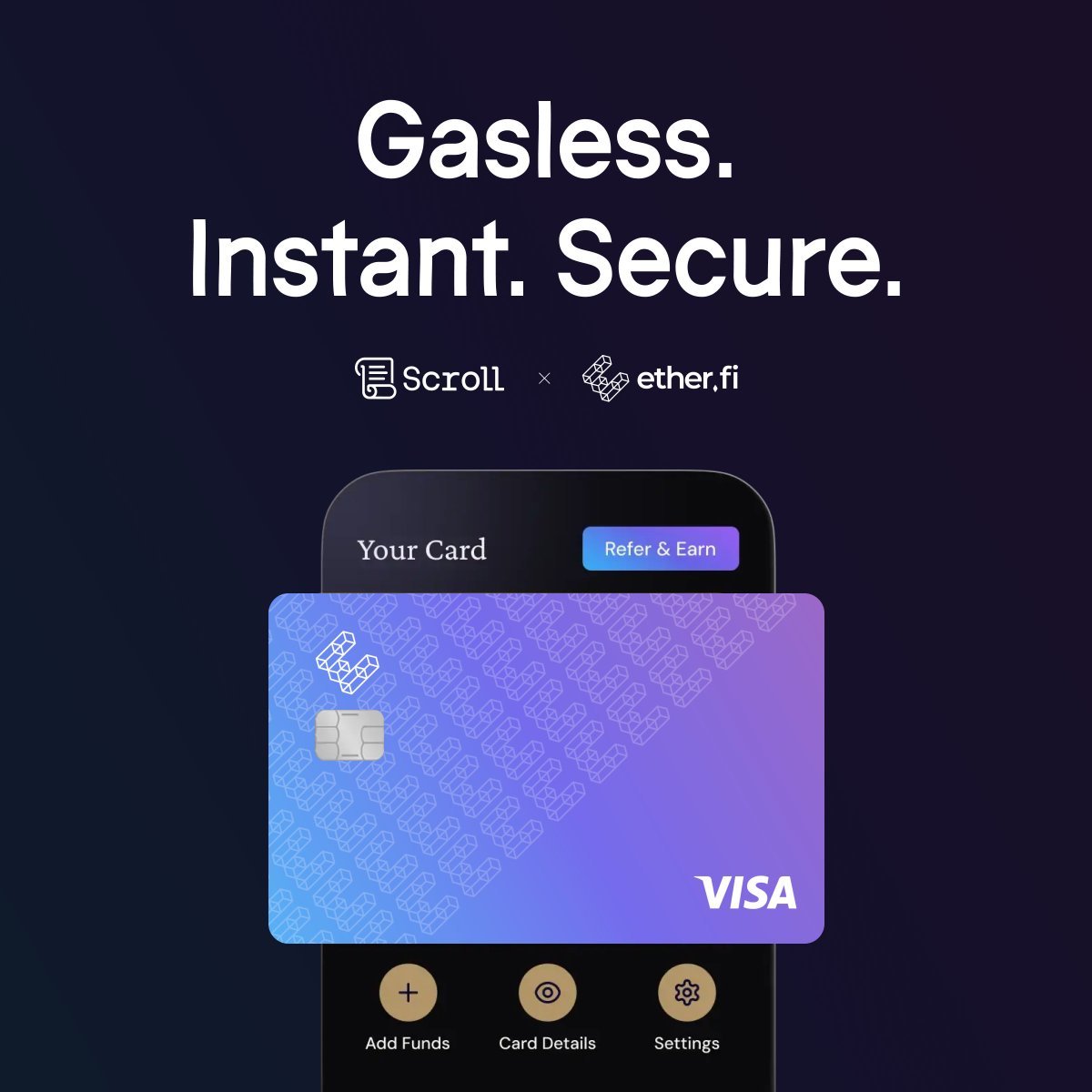
The commercial experience resembles a standard fintech account with modern conveniences. You can add the virtual card to Apple Pay or Google Pay. You can see full card numbers when you need to make online purchases. You can set spending limits and view transactions. The system supports a referral program that rewards you when people you onboard start spending, and it routinely runs promotions that boost cash back or increase the APR for yield-bearing deposits during event windows. The physical card is described as coming soon, and in the meantime, the virtual card already supports in-store tap-to-pay through your mobile wallet and traditional e-commerce flows.
Underneath the friendly interface is a set of DeFi primitives abstracted behind two spending modes. Direct pay is exactly what it sounds like: spend the asset in your vault directly, at spot conversion in the background. Borrow mode is a standard over-collateralized line that tracks Aave-like logic. The card borrows dollars against the value of your deposited token at a quoted APY; the collateral keeps earning its own organic APR and may appreciate independently. Your effective cost of spend is the borrow rate, your effective earnings are the asset’s APR plus any campaign boosters, and your net spread is the difference. This is why the speaker calls it “free money” if you are not spending too much and the spread is meaningfully positive. While that language is playful, the underlying math is straightforward and powerful when you manage it prudently.
Opening the Account and Passing KYC Without Surprises
Setting up the card begins in the most conventional way possible: you click to open the app, choose whether you are opening a personal or business account, and establish your login with an email address. A code-based verification arrives by email, and you input it to proceed. You can enable a passkey for seamless authentication on subsequent visits. The passkey step is easy to skip in a hurry, but it is worth enabling later because it reduces friction without compromising security.
Because the card rides on Visa rails and is meant for real-world spending, you must complete KYC. This is not a pseudo-anonymous prepaid voucher. Rather, it is a fully spendable card account capable of being topped up from non-custodial wallets and used globally. The KYC process will collect the usual identity and residency details and verify them. While that may feel un-DeFi at first blush, the payoff is a card that can be used for normal life without the limitations of high-fee gift card workarounds. Once you pass KYC, the account unlocks and you can start funding your vault.
Business accounts are available for real businesses and can bring separate benefits. If you are running a company that earns in crypto or wants to pay expenses in fiat while keeping treasury in yield-bearing assets, a business setup can be compelling. But for most individuals, selecting personal will be the path of least resistance.
Funding the Vault from the Wallets You Already Use
The funding flow illustrates one of the card’s biggest advantages for the on-chain native: you can send straight from the wallet that holds your assets without middlemen. In the demo, the presenter uses Rabby on a browser. You can also connect MetaMask, and the flow is similar with most injected wallets. You pick the network from which you are depositing, with Ethereum being the default for most users and Base supported as well. You choose the token you will send. The menu includes standard non-yield versions such as USDC, USDT, and wrapped ETH, and it includes the yield-bearing or “Liquid” suite that unlocks the core experience.
If you start with USDC and want to turn it into a yield-bearing dollar, you pivot to the portfolio section and deposit into LiquidUSD. That is a two-step on-chain process of approve and deposit. The result is a position in a market-neutral stablecoin that pays an organic APR. The demo cites nine percent organic with an estimated total closer to thirteen percent after campaign boosters and airdrops during the specific window shown. The exact numbers will vary over time, but the concept endures: your dollar balance can be a productive asset while sitting ready as collateral. Once you hold LiquidUSD, you return to the membership page, select add funds from crypto wallet, pick the network, choose LiquidUSD as the token, and sign to finalize the top-up into your card vault. Within moments, the vault reflects a higher LiquidUSD balance ready to be spent or pledged.
If you plan to keep exposure to ETH or BTC rather than dollars, you can skip the stablecoin path and fund with Liquid ETH or EBTC. The choice has major implications for volatility and liquidation risk if you intend to borrow against the asset, so it is worth pausing to think about your comfort level. Stablecoin collateral keeps your borrow health steady because the collateral is not fluctuating wildly. ETH or BTC collateral introduces upside potential but also drawdown risk that can squeeze your borrow headroom unless you keep conservative buffers.
The Vault as the Heart of Your Spending Strategy
The vault is where your assets live inside the card account. It is not a black box so much as a dashboard that tracks what token you have deposited, how much of it is currently earmarked for spending, and how much remains as free collateral. From the vault, you can add funds, send funds out, convert between supported tokens through the built-in interface, and toggle your spending mode. It is helpful to think of the vault like a DeFi position manager with card rails attached. When you deposit LiquidUSD, the balance in your vault is not just idle store of value; it is a productive, interest-bearing position that can be either spent directly or pledged to back a revolving spend line.
If you decide to spend directly, transactions will simply consume the token you picked in the vault. If you decide to borrow, the vault shows your current borrow utilization and gives you health indicators so you can understand your position at a glance. While the demo focuses on the LiquidUSD path for its simplicity and attractive spread, the same mechanics apply to Liquid ETH and EBTC. The difference is what happens when markets move. With LiquidUSD, your borrow health looks almost the same every day, and your risk revolves around the interest you accrue versus the yield your collateral earns. With Liquid ETH and EBTC, your borrow health rises when markets trend up, and it tightens when markets correct. You need to size borrow usage accordingly.
Direct Pay and Borrow Mode Explained with Everyday Examples
The card’s two spending modes change everything about the way you treat your assets at the point of sale. Direct pay is intuitive. If you hold LiquidUSD in the vault and use direct pay, a thirty-dollar purchase reduces your LiquidUSD by thirty dollars plus whatever conversion and processing the system requires. You are explicitly selling the asset to fund the transaction. The upside is simplicity and zero borrow interest. The downside is you give up the asset, its future yield, and any potential upside of the underlying.
Borrow mode is a different mental model. When you flip the switch, confirm by email, and wait a minute, you are telling the system that you want to keep the asset and borrow dollars against it for your everyday transactions. The demo shows a quoted borrow APY near four percent. Set against a nine percent organic APR on LiquidUSD, that creates a positive spread of roughly five percent before any campaign extras. The net effect is that your collateral keeps earning at nine while you pay four on the borrowed purchasing power, making your carry positive. The carry is not a magic trick. It depends on the relative rates staying favorable and on your discipline. If you use the card like a bottomless line, borrow interest will creep up. If you spend only what you can comfortable repay on a schedule, you preserve the spread, maintain health, and avoid liquidation risk over long horizons.
Consider a concrete example. You deposit five thousand dollars into LiquidUSD and switch to borrow mode. You go through a normal month of life and spend one thousand dollars across groceries, fuel, childcare, and online purchases. The system borrows an equivalent amount against your collateral at roughly four percent APR. Your LiquidUSD continues to earn nine percent organic and, during certain campaigns, an elevated rate. At the end of the month, you repay the thousand in fiat or from on-chain funds. Your net effect is that the collateral never left, kept earning, and the temporary borrowing cost was lower than the yield. Now imagine you repeat that rhythm for a year. The result is a spendable position that behaves more like a yield-bearing checking account than a traditional debit card.
The math changes if you fund with Liquid ETH or EBTC. Imagine you deposit five thousand dollars’ worth of Liquid ETH and keep a conservative borrow usage, spending a thousand in the same way. If ETH rallies, your collateral value rises, your effective loan-to-value improves, and the spread can look even better if Liquid ETH’s yield plus appreciation outpaces the borrowing cost. If ETH declines, your health ratio worsens, and you need to be prepared to repay sooner, add collateral, or temporarily switch to direct pay to avoid stress. The card does not eliminate market risk. It gives you a convenient toggle to pick whether and how you want to carry that risk while living your everyday life on chain.
Converting Between Assets Without Leaving the Interface
A surprisingly useful feature in practice is the built-in conversion. Crypto people are used to juggling multiple tabs, DEXes, and chains just to rebalance or harvest rewards. Inside the card interface, you can convert rewards and balances into the exposure you actually want to keep. The demo makes this tangible with Scroll token cash back. The card pays everyday rewards in Scroll, which is the token associated with the Scroll layer two. You may be delighted to speculate on Scroll or you may simply want your rewards to fortify your BTC, ETH, or stablecoin stack. You can do that in a couple of clicks. Convert Scroll to USDC if you want to remain dollar neutral. Convert Scroll to EBTC if you are building a satoshi-denominated life. Convert Scroll to LiquidUSD or Liquid ETH if you want every dollar of reward to become yield-bearing the moment it lands.
The same conversion canvas handles your broader portfolio housekeeping. If you originally funded with USDC and later decide you prefer LiquidUSD to harvest the stablecoin yield, you can deposit to the LiquidUSD module and then move that into the vault. If you find yourself overweight one asset, convert part of it to another. The key to using the card as a long-term tool is keeping your exposure and your borrow mode aligned with your goals rather than letting small frictions push you into keeping the wrong asset just because it is “already there.”
Promotions and Campaign Boosters That Amplify the Base Yield
Periodic campaigns play a significant role in the experience. In the demo, a “summer mint”-style event increases the estimated APR from the nine percent organic rate to something near thirteen percent for a set window and bumps cash back from three percent toward five percent when spending LiquidUSD via direct pay. Campaigns also reward behaviors such as minting and depositing liquid assets into the vault or spending with specific settings. The total effect is that your base economics, already attractive, can become meaningfully better during these windows. If you are thoughtful, you can time larger non-urgent expenditures or bigger collateral additions to coincide with the promotions that matter to you. That sort of tactical timing can add a percentage point here and there without extra risk. It is also a way to justify the small mental cost of optimizing a new tool. If your everyday spending is worth an extra two percentage points for a few weeks because you toggled a setting and clicked one extra button, you will feel the benefit in the quarterly and annual tallies.
Cash Back in Scroll and Why That Actually Makes Sense
Rewards accruing in the token of a layer two may sound niche, but it lines up with the way DeFi sees the world. Instead of routing cash back as fragile points in a closed loyalty program, the card routes it as an on-chain asset you can hold, convert, or deploy. If Scroll’s network is thriving, your rewards may appreciate on their own, and even if you do not want exposure, it takes moments to convert them. The important idea is that the program pays you something that can be composable. It can become part of your savings strategy rather than a coupon you forget to redeem. In the demo the presenter converts Scroll to EBTC to build a permanent BTC reserve with everyday rewards. Other people will favor LiquidUSD, EtherFi’s token, or ETH. The point is that the cash back is flexible, and this flexibility tends to produce better long-term outcomes than single-use rewards trapped inside a walled garden.
Travel, Perks, and the Everyday Details That Matter
While the walkthrough does not dwell on perks, it notes that there are benefits related to hotels and flights. Many card programs distinguish themselves with the long tail of partnerships and perks. If you are a frequent traveler, it is worth scanning the promotions and benefits pages to see where the card lines up with your routes and preferences. Tap-to-pay through Apple Pay or Google Pay works as you would expect, and adding the card to your wallet is a one-minute task once you reveal the card details. You can set spending limits if you are sharing the card with a family member or simply building guardrails for yourself.
For day-to-day peace of mind, the card interface makes it easy to view your full PAN, expiry, and CV code for online purchases, lock and unlock the card, and manage addresses. This matters in the small moments when you need to order a last-minute item and cannot find your physical wallet. Because the account is KYC’d, most merchants will treat it identically to any mainstream Visa card. That is a central advantage over half-solutions that rely on prepaid architectures and high fees to convert crypto to fiat.
The Referral Layer and How it Offsets Your Own Spend
The program includes a very clear referral mechanism. When someone uses your code and starts spending, you do not take anything out of their pocket. Instead, you receive one percent paid in Scroll tokens based on their spending volume. The friend you referred can still receive their cash back and promotional yields, and you harvest your referral fee independently. For creators, community members, or anyone with a small circle of crypto-curious friends, this becomes a soft flywheel. You onboard a handful of people who would have opened a DeFi card anyway, they enjoy their own economics, and your account picks up a new passive stream that you can convert into the exposure you want. The demo pairs this with a join-bonus structure where the referred user receives fifty dollars after their first thousand spent. Framed in ROI terms, that is a five percent instant rebate on that first tranche. Referral structures come and go and their numbers change, but the pattern is durable. If you like the card enough to evangelize it, the program rewards you in a recognizable way.
Interest-Rate Spread, Health, and the Discipline That Makes This Work
The demo’s most useful insight is not any one rate number. It is the explanation of spread. If you can borrow at roughly four percent APY while your stablecoin collateral earns nine percent APR organically and occasionally more during campaigns, your default posture becomes positive carry. That is the essence of using borrow mode intelligently. You keep the collateral working at a higher rate than the cost of the dollars you spend. Your weekly grocery run and your childcare bill become financed by a line that you pay off on a schedule, and the asset behind the scenes continues to compound.
The spread does not absolve you of the need for discipline. If you never repay, interest inevitably catches up. If you insist on carrying a high balance because the monthly accrual does not feel painful, you turn a positive-carry policy into indefensible leverage. The way to extract the value is simple and boring. Borrow for spend, take advantage of the spread while keeping your usage mild, and repay reliably. If you can automate that rhythm, the card becomes a true checking-account upgrade rather than a disguised credit line that tempts you into expensive behavior.
When your collateral is volatile, discipline includes a health buffer. If you intend to borrow against Liquid ETH or EBTC, size your utilization so that a routine market drawdown does not force you to scramble. Keep an eye on your health indicator, and if a storm is building, either repay early, add stable collateral, or temporarily flip to direct pay. In practice, many users adopt a hybrid policy: they keep LiquidUSD as the backbone for borrow mode and reserve volatile assets for direct pay or for collateral only when markets are clearly trending in their favor with ample buffer.
Gas, Fees, and the Friction You Actually Feel
One of the selling points in the walkthrough is the absence of fees to top up and spend. That does not mean there is zero friction in every path. When you deposit into a liquid asset, you perform standard on-chain approve and deposit operations and will pay gas accordingly. If you bridge or operate across Base and Ethereum, you will incur the usual network costs. The card itself is engineered to be economically neutral at the front end so that you are not paying a visible tax for the privilege of spending crypto. Instead, your economics are determined by the borrow rate you accept, the yield your collateral earns, any conversion spreads when you shift between tokens, and the promotions you capture. In practice, the true frictions are the ones you already know as a DeFi user: gas to approve and deposit, slippage or spread on conversions, and patience required when networks are congested. Compared to most alternatives that ask you to sell into fiat rails with explicit top-up fees, the card’s path feels frugal and sensible.
Security, Passkeys, and the Hygiene of a Spendable Vault
Security starts with the basics. Enable the passkey for quick and safe logins. Lock down your email because it holds the keys to mode switches and confirmations. Treat your connected wallet with the same respect you give your main on-chain accounts. Use a hardware wallet if you are depositing larger sums, and prefer allow-listing and limited approvals whenever possible. The card account itself is built to handle spend securely in the traditional sense. You can freeze and unfreeze the card, replace details if compromised, and rely on the familiar merchant dispute process associated with Visa rails. The hybrid nature of the system means you have both Web3 and Web2 surfaces to defend. Good hygiene on both ends pays dividends.
Tax, Accounting, and the Boring Stuff That Saves You Later
While the walkthrough does not wade into tax advice, the difference between direct pay and borrow mode has tax implications in many jurisdictions. Selling a token to fund a purchase may be a taxable disposal. Borrowing dollars against an asset to make a purchase generally is not a taxable event, though the details vary by country. The rewards you earn as cash back and the yield you earn on your liquid positions may be taxable income. The referrer rewards you receive are likewise typically treated as income at the fair market value when received. None of this is complicated if you keep records. Your wallet, the vault, and any tracking tools you already use can capture the necessary data. The prize for staying organized is that you can use the card fluidly all year without creating an April crisis.
Everyday Life on a Yield-Backed Card
The abstract pitch becomes real when you map the card onto a week in your life. On Monday, you connect your Rabby or MetaMask, deposit USDC, and mint LiquidUSD. On Tuesday, you top up the vault with your LiquidUSD and switch to borrow mode. Your child’s school lunches, your commute fuel, and your grocery run become transactions that draw against your LiquidUSD at roughly four percent APY while the collateral itself is earning nine percent APR organically. On Friday, you notice a promotion that boosts your effective stablecoin APR for a few weeks. You add an extra thousand dollars to the vault to take advantage of the window. The following week, you convert accumulated Scroll rewards into EBTC because you prefer to measure your savings in satoshis. At the end of the month, you repay your borrowed line from your fiat paycheck or from a small conversion out of your on-chain cash, keeping the position tidy.
If you travel, you add the card to Apple Pay and tap through airport terminals like any other card. If you are a homebody, you enjoy the routine comfort that your “checking account” is not a zero-yield sinkhole. If you are a builder or creator, you share your referral code with a few friends who ask how you are getting three to five percent back on spend while your balance grows. Every part of that story is ordinary in the sense that it maps to decisions you already make. The card simply changes the substrate so that the default is productive.
Using EBTC and Liquid ETH Without Tempting Fate
For many, the most exciting feature is the ability to fund with EBTC or Liquid ETH and never sell the underlying. The dream is resilient collateral that appreciates faster than you can spend against it, making your month-to-month expenses feel like they are funded by time rather than labor. Dreams need guardrails. If you intend to live that way, be conservative with borrow amounts, especially in choppy markets. One prudent approach is to keep your borrow usage low enough that a twenty to thirty percent drawdown will not stress your position. You can also hedge implicitly by keeping a portion of your vault in LiquidUSD so that part of your collateral is immune to drawdowns.
The reward for doing this thoughtfully is compounding upside. When ETH rallies, your spend line gets safer and your remaining credit headroom grows. You can harvest small pieces of that headroom to fund life while leaving the base position intact. When BTC rallies, the same logic applies to EBTC. The card cannot repeal volatility, but it lets you use your preferred money while insulating your lifestyle from unconditional selling.
A Practical Walkthrough of the Interface
It is worth reconstructing the clicks described in the demo so you have a sense memory for them. You land on the app and either sign in or create an account. You choose personal, enter an email, receive a code, and enter it. The app offers a passkey; you accept or skip. You arrive at an onboarding carousel explaining club benefits, campaign participation, and conferences where membership might grant perks. You see a callout that a physical card is on the way and that you can earn three percent cash back and spend worldwide. A vault section appears inviting you to deposit assets and choose which to spend against.
You click to activate your cash card, pass the KYC flow, and land on your live account. You click add funds. The menu shows bank transfer as a future option and offers a shareable deposit address if you want someone else to fund you. You choose to send from a connected wallet and pick Ethereum or Base. You select from tokens including USDC, USDT, wrapped ETH, EtherFi, EBTC, and the liquid suite. You decide to start with USDC and then head to the portfolio area to deposit into LiquidUSD. You approve, then deposit, perhaps choosing five hundred dollars as your first test. When the deposit confirms, you return to membership, click add funds, select Ethereum, pick LiquidUSD, and hit max. You sign, the vault shows the extra five hundred, and you smile at the speed.
You glance at the spending mode and see it is set to direct pay by default. You click to switch to borrow mode. A modal shows the borrow APY, perhaps near four percent, and you confirm. An email arrives, you click to authorize, and a minute later the interface flips to borrow. You visit the cash tab and confirm your card exists, tapping to reveal card details if you need them. You add the card to Apple Pay or Google Pay. You set a spending limit for the month to match your plan to repay weekly. You make a few purchases. The next day you visit the promotions page, see that a campaign boosts your LiquidUSD APR and increases cash back for direct pay spending in specific categories, and you note which path suits you this week. On Friday, you look at your rewards and see Scroll tokens accruing. You click convert, pick EBTC, and watch your BTC savings notch up by a few thousand sats for free.
Where This Sits in the Broader DeFi Landscape
The EtherFi Cash Card plugs a value gap that many prior solutions left open. Prepaid crypto cards often required you to sell the asset into fiat at top-up time, charged fees for the privilege, and punished you if you forgot to keep a positive balance. Custodial solutions sometimes delivered slick user experiences at the cost of surrendering keys and missing out on yield. The vault-plus-mode model is different. It respects that your base position should stay working unless you choose otherwise and wraps that with Visa rails so you can live. It respects that DeFi users have wallets they trust and that the top-up flow has to be painless. It takes seriously the idea that yield and cash back are not marketing slogans but actual pillars of the household budget that can be measured and optimized.
This is also a small taste of where consumer finance is heading. The line between checking, savings, credit, and investing is already blurry. A spendable account that earns nine percent on dollars while supporting four percent borrowing costs to fund purchases is something a traditional bank can barely conceptualize, never mind offer without dozens of conditions. In DeFi, it is straightforward because the primitives exist and can be stitched together. If you understand that logic, the card stops being a novelty and becomes the obvious way to live on chain.
Risk, Edge Cases, and the Boundaries You Should Respect
Even well-designed tools require respect for risk. Borrow mode is safe if you keep your usage modest and your repayment cadence steady. It is risky if you treat it as free money and let balances grow. LiquidUSD’s organic APR can change. Borrow APYs can rise. Promotions expire, and you should not build your budget around temporary boosters. If you collateralize with volatile assets and the market turns, you need to act rather than hope. If you are new to over-collateralized borrowing, start with small amounts and build muscle memory for how the dashboard behaves through a full month of life.
On the operational side, ensure that you are comfortable with the wallet connection model and that you recognize and verify any contract interactions. The interface is designed to minimize approvals and complexity, but your attention is still the ultimate guardrail. When you convert rewards, recognize that conversions carry spreads and, in illiquid moments, slippage. If you chase a reward token higher because it just rallied, you are speculating; be honest with yourself and size accordingly.
Practical Strategies That People Actually Use
There are a handful of patterns that have emerged as sensible defaults. The first is the stablecore plan. Deposit an amount of LiquidUSD that roughly matches one or two months of expected spend, switch to borrow mode, and repay every week. Keep a small buffer in direct pay mode for odd purchases you want to route without borrowing. Capture promotions opportunistically and convert rewards to whatever long-term asset you are accumulating. The second pattern is satellite bets. Keep your core in LiquidUSD but deposit a smaller amount of Liquid ETH or EBTC as an unspent, unborrowed position that you periodically top up with converted rewards. You still spend against the stablecore, but you keep a toe in the upside you care about. The third pattern is seasonal leverage. When markets are trending gently higher and you are confident in your risk controls, borrow very lightly against Liquid ETH or EBTC and repay more aggressively to keep utilization trivial. In down or choppy periods, pivot your spending back to stablecore and sit tight.
These are not prescriptions, just lived examples that map to the tools the card provides. The common threads are moderation in borrow usage, steady repayment rhythms, opportunistic capture of promotions, and immediate conversion of rewards into your preferred savings exposure.
Troubleshooting the Little Things That Can Throw You
Every new system has rough edges that are easy to smooth with a few reminders. If your borrow mode toggle does not take effect immediately, remember to confirm via the email link and give it a minute to switch. If a deposit does not appear in the vault, check which network you sent from and which token you selected, and confirm the transaction hash shows success. If a conversion fails, check allowances and approvals; the interface will usually prompt you to approve the token. If you are adding the card to Apple Pay or Google Pay and the wallet refuses, ensure your billing address is complete and matches your identity details. If a merchant declines the card, try again through your mobile wallet tap-to-pay; many transient declines result from 3-D Secure or fraud filters and resolve on a second attempt. If you are unsure whether a campaign applies to your specific spending mode or token, open the promotions page and read the scope carefully; the copy typically spells out whether the booster is for direct pay in LiquidUSD or for deposits into the vault.
The Human Side: Families, Homebodies, and Road Warriors
The walkthrough mentions four children and a homebody lifestyle, a useful reminder that most people are not optimizing points for a fifth-freedom route to Doha. The most compelling use of the card for families is banal and beautiful. Your ordinary expenses can be funded through a mechanism that grows the family’s reserves instead of eroding them, and your rewards can quietly accumulate in a long-term store you believe in. If you travel, the card meets you there with global acceptance and a rotating roster of travel-friendly promotions, but the core value does not depend on elite status games. It depends on a sound spread and a gentle habit of paying down the borrow line.
From Curiosity to Confidence: A Thirty-Day Plan
Confidence with new financial tools comes from using them in low-stakes ways until their behavior is second nature. A practical thirty-day plan might look like this, without the crutch of checklists. Start by depositing a modest sum of USDC you can afford to experiment with and mint LiquidUSD. Add it to the vault and spend in direct pay mode for a few days so you see the simplest flow. Switch to borrow mode for the next two weeks and keep a running note of how much you spend and how the borrow line accrues. At the end of each week, repay the amount you spent. During this time, convert rewards once so you learn the path from Scroll to your preferred asset. In the final week, try a small deposit of Liquid ETH or EBTC to see how your health ratios look when the collateral is volatile. By the end of the month, the interface will feel as normal as logging in to your bank, and you will know exactly which mode you prefer and why.
Final Thoughts: A Checking Account That Finally Pulls Its Weight
If you strip away the marketing and focus on the mechanics described in the demo, the EtherFi Cash Card is striking because it grants something simple that has been hard to find: an everyday spending tool that preserves and even enhances the economics of holding crypto productively. You can keep a meaningful APR on stablecoins while you spend against them at a lower rate. You can maintain ETH and BTC exposure without selling while still paying for life. You can refill from the wallets you prefer without paying top-up tolls, and you can harvest rewards in a composable token you can convert into your long-term savings with a click. The vault keeps your assets in one place; the two spending modes let you pick your risk and tax profile moment by moment.
For the first time, the right move with your everyday money can also be the smart move with your on-chain portfolio. That coherence changes behavior. It encourages you to keep more of your liquidity on chain where it can work. It encourages you to repay reliably because the spread rewards discipline. It encourages you to think in terms of net position rather than isolated transactions. That is what good financial tools do. They do not merely lower fees or add perks; they change the default so that the path of least resistance is the path of greatest benefit.
The card is not a miracle. It is a synthesis of primitives and rails, and like any synthesis, it depends on you to use it wisely. Keep your borrow usage modest. Repay on a schedule. Favor LiquidUSD as the backbone and add volatile assets when the buffer is wide and your conviction is high. Convert rewards into the long-term exposure you actually want. Note the campaigns, but do not build your life around them. If you hold to those habits, the card does what the demo promises in spirit. It makes your money feel more like a partner than a passenger, and it lets you carry the logic of DeFi to the checkout counter without apology.